
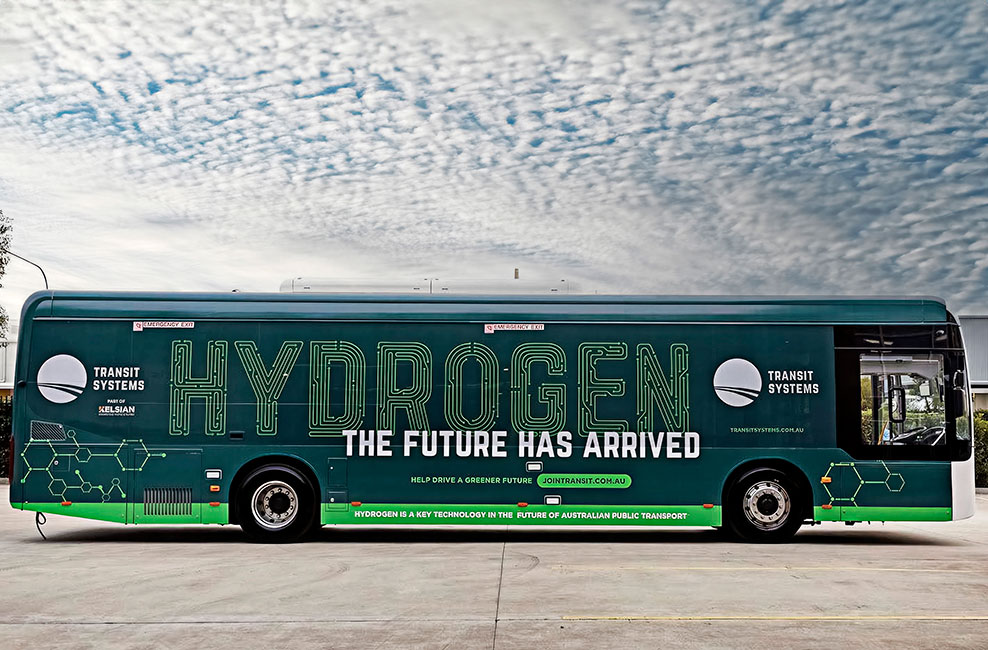
The State Government will showcase a clean, green public transport future with hybrid trains and hydrogen buses to join a full-battery electric bus as the latest technology to be trialled across the network. A ground-breaking, two-year hydrogen bus trial will involve two vehicles based at the Morphettville bus depot deployed on routes across Adelaide from late August. The first of these hydrogen buses has arrived in Adelaide, wrapped in a striking green decal.
In collaboration with Foton Mobility, BOC and H2H Energy, operator Torrens Transit will then begin internal testing of two Foton Hydrogen Fuel Cell Buses from the Morphettville depot before being released for operation.
Hydrogen Fuel Cell Buses (HFCB) represent a rapidly emerging, green alternative technology. HFCB trials and fleet implementations are increasingly occurring across public transport networks globally from London to Beijing and Cologne – which has a similar population size to Adelaide.
The benefits of hydrogen-powered vehicles over battery electric buses include faster refuelling and greater range, which may be critical to delivering services to the outer metro areas and into the regions.
Hydrogen complements battery electric vehicle technology by providing a viable cleaner, greener, emissions-free technology that can power buses, trains or other heavy vehicles carrying heavy loads. Hydrogen fuel carries significantly more energy than the equivalent weight of batteries, which is important as the State Government evaluates future technology options, including powering trains on the Belair, Outer Harbor lines and Grange and Port Dock connections.
As well as being better for the environment, full-battery electric buses offer a range of benefits for passengers. They offer more space and better comfort and accessibility while eliminating noise and fuel-based pollution. A further five full-battery electric buses are on order, pending the results of this trial.
Adelaide Metro is committed to transitioning to a zero-emissions public transport system to support the State Government’s net zero emissions by 2050 target.