
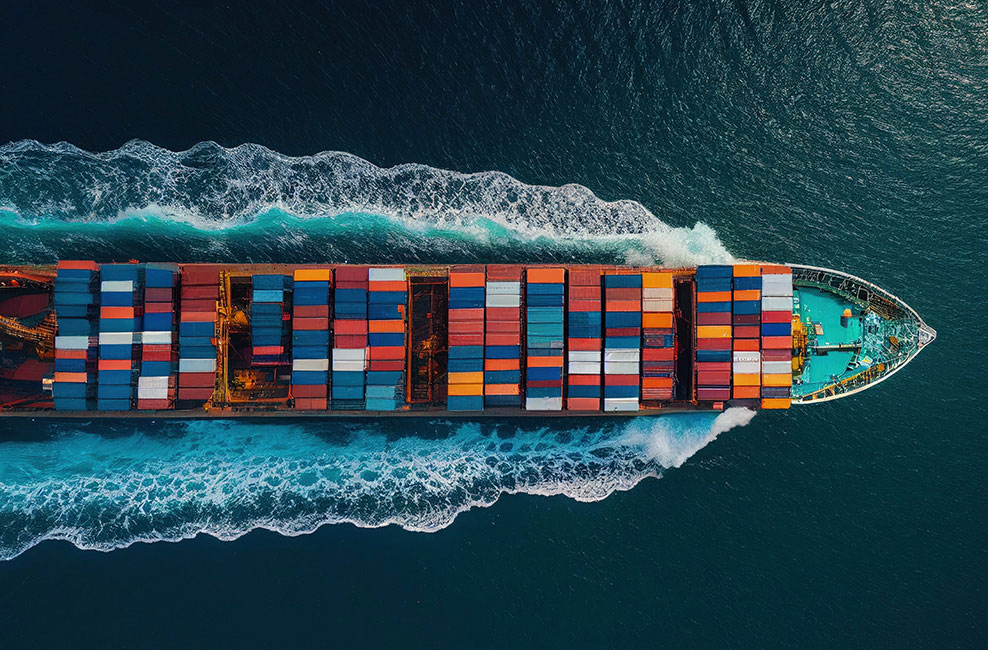
newcleo, the company developing innovative Generation IV reactors which use nuclear waste as fuel, recently announced that it has signed an agreement with Fincantieri, one of the largest shipbuilding companies in the world, and RINA, the inspection, certification, ship classification and consulting engineering multinational.
Under the terms of the agreement, the three companies are combining their deep international expertise and innovation experience to carry out together a feasibility study for nuclear applications to the shipping industry, including newcleo’s lead-cooled small modular reactors (SMRs) technology.
The deployment of newcleo’s innovative LFR (Lead-cooled Fast Reactor) for naval propulsion would involve placing a closed mini reactor on vessels as a small nuclear battery producing a 30MW electric output. This would require infrequent refuelling (only once every 10-15 years), very limited maintenance and easy replacement at end-of-life.
According to the company, using its nuclear technology to power marine vessels is both clean and safe, and can play a significant role in helping to rapidly decarbonise a sector grappling with huge fossil fuel consumption and its consequent carbon emissions.
The shipping industry, via the International Maritime Organization (IMO), recently approved new targets for GHG emission reduction, to reach net-zero GHG emissions by or close to 2050.
While the shipping industry still carries 90% of the world’s goods, and the fourth IMO GHG Study 2020 confirms that its carbon dioxide emissions are less than 3% of the total global man-made CO2 emissions, the actions of the big players of this industry have the potential to drive trends and markets.
Stefano Buono, newcleo Chairman and CEO, commented:
“I am delighted that we are launching a project for civil nuclear naval propulsion with this important feasibility study. Fincantieri and RINA are two global leaders in the shipping sector, and combining their expertise with our technology innovation can bring a real solution to the issue of carbon emissions in maritime transport.”
“From our conception, newcleo’s ambition is to contribute to accelerating decarbonisation and providing clean, sustainable and affordable energy to meet the needs of communities and businesses,” Mr Buono added. “I look forward to the results of the feasibility study and the next steps of the project.”
According to newcleo, its reactors are designed to safeguard the marine ecosystem in the event of an accident. With newcleo’s design, the liquid lead inside the reactor solidifies as it cools down in contact with the cold water, enclosing the reactor core in a solid casing, and containing all radiation thanks to the shielding properties of lead.
The company also claims that its naval propulsion reactors would eliminate the current need for frequent refuelling, and at the end of its life, the whole LFR unit would be simply removed and replaced with a new one in the ship, with the spent unit taken away for decommissioning and reprocessing.