
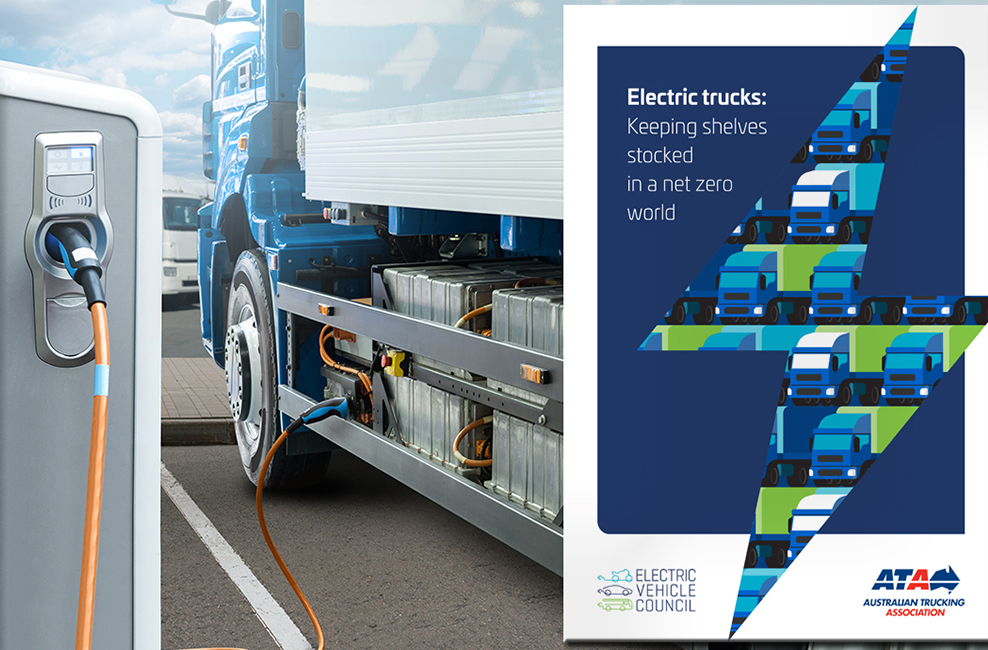
In an Australian first, the Electric Vehicle Council (EVC) and the Australian Trucking Association (ATA) have collaborated to develop the policies necessary to drive Australian trucking into a bright electric future.
Electrification would assist trucking businesses and supply chains by ending volatile diesel costs, reducing maintenance costs, improving urban efficiency, and delivering better conditions for truck drivers. However, Australia currently lags most of the world in the electrification of trucks making the need for reform urgent. Of the 58 electric truck models available in North America, Europe, and China only 14 are available to the Australian market.
Key recommendations from the new EVC/ATA policy agreement include exempting electric trucks from urban curfews, changing Australian weight and width limits to accommodate batteries, and exempting electric trucks form stamp duty.
Behyad Jafari CEO, Electric Vehicle Council, said that while every government in Australia has committed to net-zero, it can’t be achieved without decarbonising the transport sector.
“Curfew-free operations are a huge opportunity, creating benefits for operators optimising fleet operations and to the community through reducing peak hour traffic and congestion,” Mr Jafari said.
“We need the government to read these recommendations and get moving fast. If we implement them swiftly the benefits to Australian trucking, our economy, and our environment will be truly massive.”
The AdBlue shortage crisis was a potent warning about our extreme fuel insecurity,” Mr Jafari added. “Why should Australia be dependent on China and the Middle East to keep itself moving when we could be using homegrown power? Being able to power our supply chains with local electricity is a surely a national sovereignty imperative.”
Australian Trucking Association Chair, David Smith says electric power will be a game changer for the industry.
“It costs about $117 to fuel a diesel truck for 300 kilometres, but just $18 for an electric truck,” Mr Smith said. “If Australia gets left behind on the transition to electric and zero emission trucks, we risk our supply chains and exporters getting stuck with high, globally uncompetitive per km freight costs.”
“Trucking operators face a number of barriers to buy and use an electric truck and these must be addressed to lower freight costs, improve fuel security and reduce emissions,” Mr Smith concluded.
EVC/ATA policy recommendations:
Australia currently lags most of the world in the electrification of trucks making the need for reform urgent. Of the 58 electric truck models available in North America, Europe, and China only 14 are available to the Australian market.
Key recommendations from the new EVC/ATA policy agreement include:
- Truck width should be increased to align with standards used by major supplier economies
- One tonne concession for electric and zero emission
- Electric trucks to be exempt from urban curfews
- Mandate Euro VI emissions standards for new heavy vehicle models from 2024
- Incentive payment to reduce the cost of installing charging infrastructure at depots
- Investment in public charging infrastructure
- Incentive payment to reduce the upfront purchase price difference between electric/zero emission trucks and internal combustion engine trucks
- Exempt electric and zero emission trucks from stamp duty
- Set sales target for zero-emission trucks of 30 per cent by 2030 and 100 per cent by 2040
A copy of the report: Electric trucks: keeping shelves stocked in a net-zero world is available to download from: https://electricvehiclecouncil.com.au/